Bottle Opener Stress Analysis
Bottle Opener Stress Analysis
Bottle Opener Stress Analysis
Academic | Individual | 2024
Academic | Individual | 2024
Convergence study and stress analysis using ANSYS to analyze two bottle opener designs
ANSYS
Beam Theory
Convergence Study
Project premise
This project evaluates two bottle opener designs (right) to provide a beverage company with a recommendation on which design is stronger and should be manufactured.
A convergence study was performed with 4 different mesh types to determine the best mesh for each design. Due to the complex geometry and varying cross-sectional areas of each design, 3D stress analysis is used.
The selected mesh was then used to determine the maximum force than can be applied and corresponding deformation for each design.
Finally, beam theory was used to perform hand calculations and verify these deformation values.

Geometries of Design A and B
01
Simulation Setup
Boundary Conditions
The faces that would be in contact with the bottle cap are assigned a fixed boundary condition. For the convergence study, the edge where the user pulls upward is assigned a force of 100 N in the vertical (y) direction.

02
Convergence Study
Determining the Optimal Mesh
Under the boundary and load conditions defined above, the following mesh types were tested to calculate the stress distributions in each design:
Linear tetrahedral
Quadratic Tetrahedral
Linear hex-dominant (hexahedral)
Quadratic hex-dominant (hexahedral)

Convergence Study, Design A

Convergence Study, Design B
Design A: optimal mesh was the quadratic hex-dominant mesh. This showed a convergence at 6572 elements and a maximum Von Mises stress of 240 MPa.
Design B: optimal mesh was the quadratic hex-dominant mesh. This showed a convergence at 26,270 elements and a maximum Von Mises stress of 64 MPa.
Design A: optimal mesh was the quadratic hex-dominant mesh. This showed a convergence at 6572 elements and a maximum Von Mises stress of 240 MPa.
Design B: optimal mesh was the quadratic hex-dominant mesh. This showed a convergence at 26,270 elements and a maximum Von Mises stress of 64 MPa.
Findings
03
Stress Analysis
Maximum Load
For each design, arbitrary loads were tested to find the magnitude that would result in the maximum Von Mises stress that exceeds to the material’s yield strength (550 MPa).

Von-Mises Stress Plot for an applied load of 229 N, Design A

Von-Mises Stress Plot for an applied load of 860N, Design B
The maximum force that can be applied to the end of Design A is ~229 N. This applied force results in a maximum Von Mises stress of 549.95 MPa.
The maximum force that can be applied to the end of Design B is ~860 N. This applied force results in a maximum Von Mises stress of 550.65 MPa.
Total Deformation
For each design, arbitrary loads were tested to find the magnitude that would result in the maximum Von Mises stress that exceeds to the material’s yield strength (550 MPa).

Von-Mises Stress Plot for an applied load of 229 N, Design A

Von-Mises Stress Plot for an applied load of 860N, Design B
The maximum deformation for design A is 1.99 mm, which occurs at the end where the load is applied.
The maximum deformation for design B is 0.58 mm, which occurs at the top end where the load is applied.
Design A has a larger deflection than Design B because it has a smaller cross-sectional area that is not able to resist the bending moment as well.
04
Sanity Check: Analytical Solution
Applying Beam Theory
The analytical solution is obtained by simplifying the bottle opener as a cantilever beam with a fixed boundary condition on one side and a free end on the other side. A point load is applied to the free end of the beam.
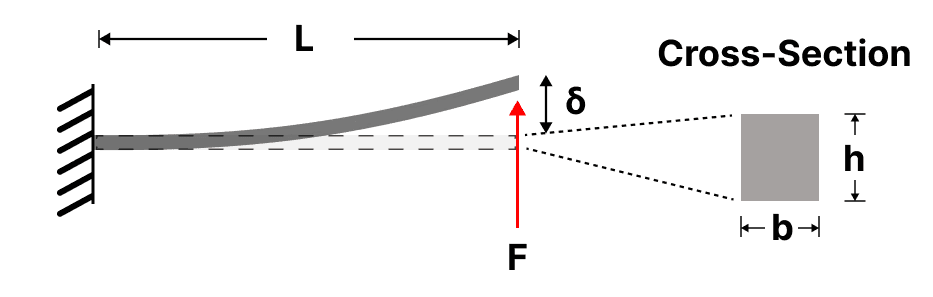
Additional Assumptions:
Plane sections remain plane
Linear elastic material
Negligible rotations
Loads are applied to a single point
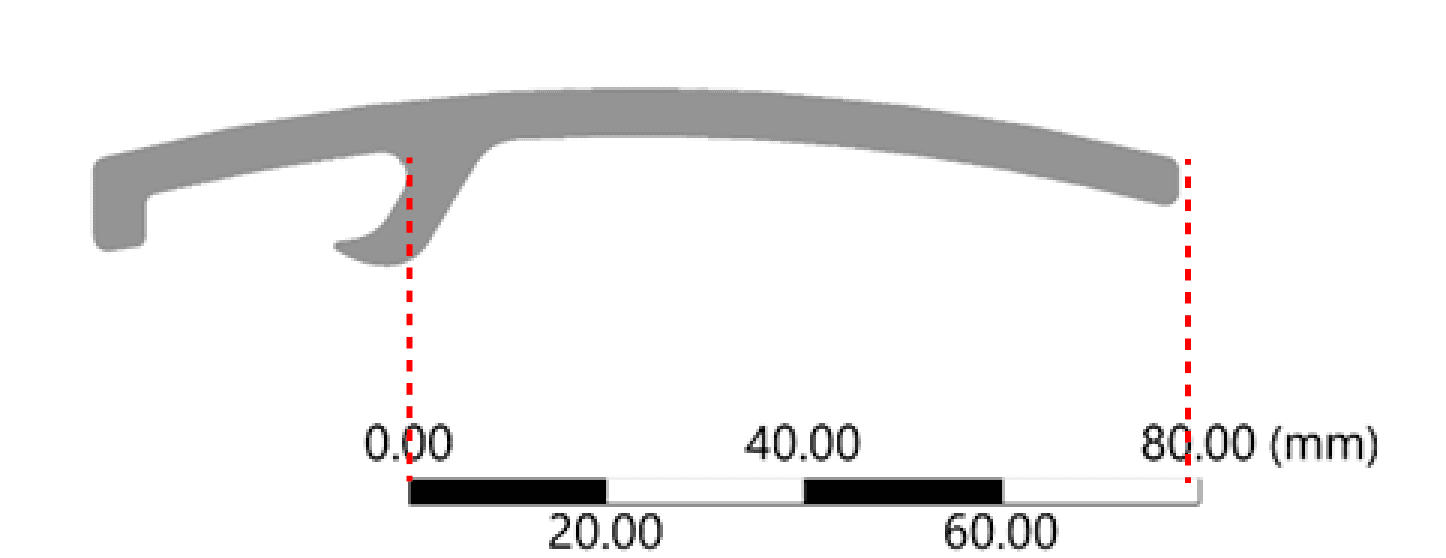
For Design A, the length is taken as the distance from the free end to the fixed boundary condition. The length was measured to be 80 mm.

For Design B, the length is taken to be the distance from the fixed face to the middle of the end face because the load is applied along a curved end face (tail). This length was measured to be 65 mm.
Calculating Deflection
The moment of inertia of each simplified beam is calculated with the width and height of the cross sections. Unlike Design A, which has a uniform height, Design B's height was taken as the average of the and max. and min. heights. The beam deflection calculations of Design A (right) and Design B (left) are shown below.
Results
Both analytical solutions have a smaller maximum deflection value than the FEA solutions. This is likely due to factors such as geometry assumptions, the neglection of rotation in beam theory, and type of applied load (point vs. distributed).

05
Conclusion
Findings
Based on the mesh convergence study:
The best mesh type for Design A is a quadratic hex-dominant mesh with 6,572 elements.
The best mesh type of Design B is a quadratic hex-dominant mesh with 26,270.
These meshes were used to calculate the maximum load that can be applied until the maximum Von Mises stress in the bottle opener exceeds the yield stress (550 MPa).
The maximum force for Design A was 229 N
The maximum force for Design B was 860 N.
The corresponding maximum deflection were:
Design A: 1.99 mm for Design A
Design B: 0.58 mm for Design B.
Based on these results, it can be concluded that Design B is the stronger design for the bottle opener and should be manufactured instead of Design A.
03
Stress Analysis
Maximum Load
For each design, arbitrary loads were tested to find the magnitude that would result in the maximum Von Mises stress that exceeds to the material’s yield strength (550 MPa).
Von-Mises Stress Plot for an applied load of 229 N, Design A
Von-Mises Stress Plot for an applied load of 860N, Design B
The maximum force that can be applied to the end of Design A is ~229 N. This applied force results in a maximum Von Mises stress of 549.95 MPa.
The maximum force that can be applied to the end of Design B is ~860 N. This applied force results in a maximum Von Mises stress of 550.65 MPa.
Total Deformation
For each design, arbitrary loads were tested to find the magnitude that would result in the maximum Von Mises stress that exceeds to the material’s yield strength (550 MPa).
Von-Mises Stress Plot for an applied load of 229 N, Design A
Von-Mises Stress Plot for an applied load of 860N, Design B
The maximum deformation for design A is 1.99 mm, which occurs at the end where the load is applied.
The maximum deformation for design B is 0.58 mm, which occurs at the top end where the load is applied.
Design A has a larger deflection than Design B because it has a smaller cross-sectional area that is not able to resist the bending moment as well.
04
Sanity Check: Analytical Solution
Applying Beam Theory
The analytical solution is obtained by simplifying the bottle opener as a cantilever beam with a fixed boundary condition on one side and a free end on the other side. A point load is applied to the free end of the beam.
Additional Assumptions:
Plane sections remain plane
Linear elastic material
Negligible rotations
Loads are applied to a single point
For Design A, the length is taken as the distance from the free end to the fixed boundary condition. The length was measured to be 80 mm.
For Design B, the length is taken to be the distance from the fixed face to the middle of the end face because the load is applied along a curved end face (tail). This length was measured to be 65 mm.
Calculating Deflection
The moment of inertia of each simplified beam is calculated with the width and height of the cross sections. Unlike Design A, which has a uniform height, Design B's height was taken as the average of the and max. and min. heights. The beam deflection calculations of Design A (right) and Design B (left) are shown below.
Results
Both analytical solutions have a smaller maximum deflection value than the FEA solutions. This is likely due to factors such as geometry assumptions, the neglection of rotation in beam theory, and type of applied load (point vs. distributed).
05
Conclusion
Findings
Based on the mesh convergence study:
The best mesh type for Design A is a quadratic hex-dominant mesh with 6,572 elements.
The best mesh type of Design B is a quadratic hex-dominant mesh with 26,270.
These meshes were used to calculate the maximum load that can be applied until the maximum Von Mises stress in the bottle opener exceeds the yield stress (550 MPa).
The maximum force for Design A was 229 N
The maximum force for Design B was 860 N.
The corresponding maximum deflection were:
Design A: 1.99 mm for Design A
Design B: 0.58 mm for Design B.
Based on these results, it can be concluded that Design B is the stronger design for the bottle opener and should be manufactured instead of Design A.
03
Stress Analysis
Maximum Load
For each design, arbitrary loads were tested to find the magnitude that would result in the maximum Von Mises stress that exceeds to the material’s yield strength (550 MPa).
Von-Mises Stress Plot for an applied load of 229 N, Design A
Von-Mises Stress Plot for an applied load of 860N, Design B
The maximum force that can be applied to the end of Design A is ~229 N. This applied force results in a maximum Von Mises stress of 549.95 MPa.
The maximum force that can be applied to the end of Design B is ~860 N. This applied force results in a maximum Von Mises stress of 550.65 MPa.
Total Deformation
For each design, arbitrary loads were tested to find the magnitude that would result in the maximum Von Mises stress that exceeds to the material’s yield strength (550 MPa).
Von-Mises Stress Plot for an applied load of 229 N, Design A
Von-Mises Stress Plot for an applied load of 860N, Design B
The maximum deformation for design A is 1.99 mm, which occurs at the end where the load is applied.
The maximum deformation for design B is 0.58 mm, which occurs at the top end where the load is applied.
Design A has a larger deflection than Design B because it has a smaller cross-sectional area that is not able to resist the bending moment as well.
04
Sanity Check: Analytical Solution
Applying Beam Theory
The analytical solution is obtained by simplifying the bottle opener as a cantilever beam with a fixed boundary condition on one side and a free end on the other side. A point load is applied to the free end of the beam.
Additional Assumptions:
Plane sections remain plane
Linear elastic material
Negligible rotations
Loads are applied to a single point
For Design A, the length is taken as the distance from the free end to the fixed boundary condition. The length was measured to be 80 mm.
For Design B, the length is taken to be the distance from the fixed face to the middle of the end face because the load is applied along a curved end face (tail). This length was measured to be 65 mm.
Calculating Deflection
The moment of inertia of each simplified beam is calculated with the width and height of the cross sections. Unlike Design A, which has a uniform height, Design B's height was taken as the average of the and max. and min. heights. The beam deflection calculations of Design A (right) and Design B (left) are shown below.
Results
Both analytical solutions have a smaller maximum deflection value than the FEA solutions. This is likely due to factors such as geometry assumptions, the neglection of rotation in beam theory, and type of applied load (point vs. distributed).
05
Conclusion
Findings
Based on the mesh convergence study:
The best mesh type for Design A is a quadratic hex-dominant mesh with 6,572 elements.
The best mesh type of Design B is a quadratic hex-dominant mesh with 26,270.
These meshes were used to calculate the maximum load that can be applied until the maximum Von Mises stress in the bottle opener exceeds the yield stress (550 MPa).
The maximum force for Design A was 229 N
The maximum force for Design B was 860 N.
The corresponding maximum deflection were:
Design A: 1.99 mm for Design A
Design B: 0.58 mm for Design B.
Based on these results, it can be concluded that Design B is the stronger design for the bottle opener and should be manufactured instead of Design A.
Let's Get in Touch!
I'd love to see what we can accomplish.
Let's Get in Touch!
I'd love to see what we can accomplish.
Let's Get in Touch!
I'd love to see what we can accomplish.