Systems Design
User-Centered Design
Research
Lower-limb prosthetics are essential devices that allow individuals to regain physical independence in their lives.
The high cost of these complicated devices—upwards of tens of thousands of dollars—make them largely unaffordable for individuals to purchase on their own. Insurance coverage of these devices is a key factor in enabling the individuals to live the lives they deserve.
The Center for Medicare and Medicaid Services (CMS) determines insurance coverage through a categorization system called K-levels. K-levels, ranging from 0-4, correspond to a patient's "potential for rehabilitation". The lack of standardization in the current evaluation process creates a large degree of ambiguity and subjectivity, making it difficult for individuals to receive the rehabilitation support they need.
A Holistic Evaluation of the patient's rehabilitation potential
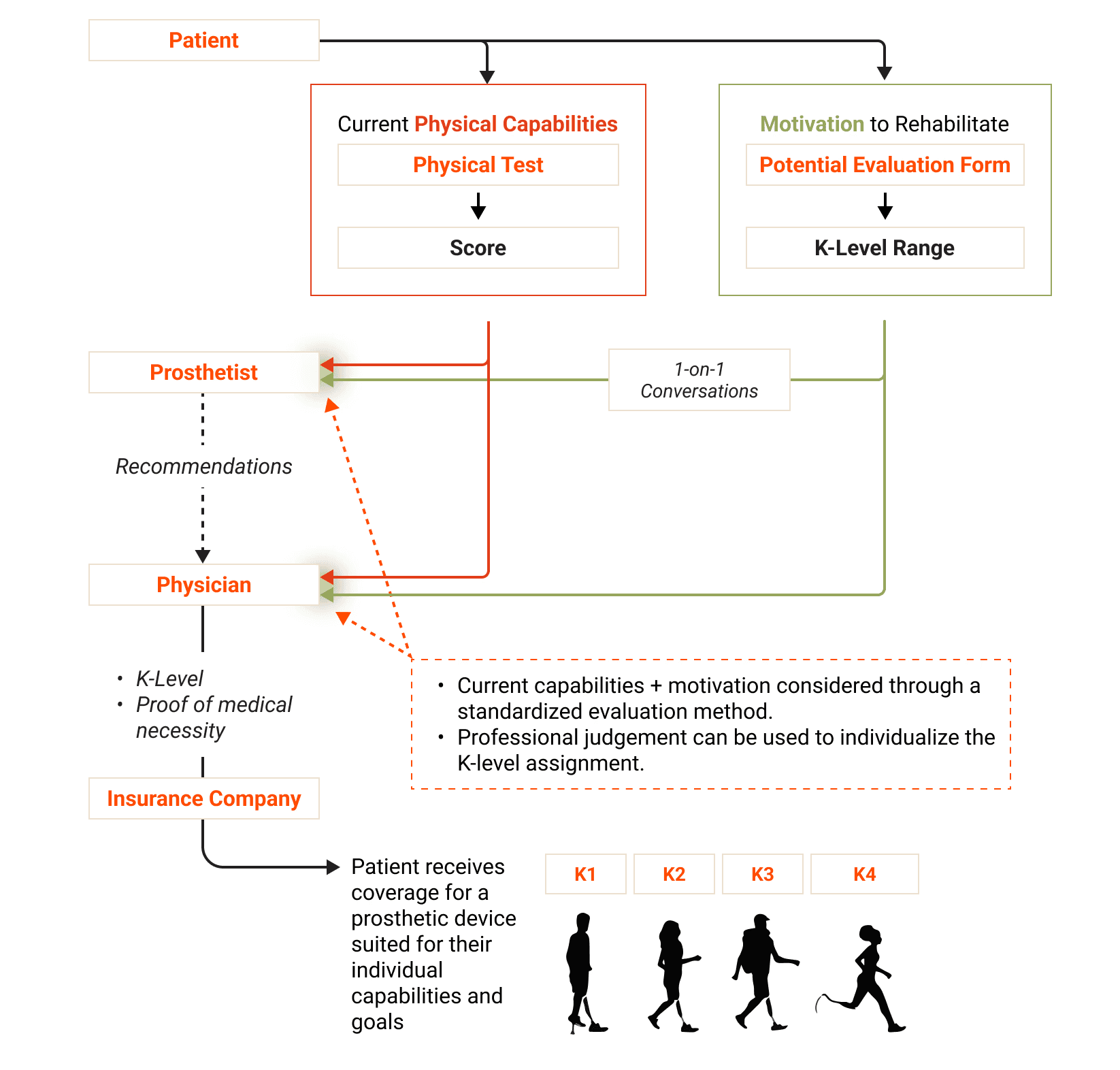
The revised system streamlines the assignment process: standardized scoring system increases the differentiation of physical capabilities between K-levels while retaining the subjectivity to best suit the unique cases some patients may have.
Physical examination
This gives the physician and insurance company context on the patient's current capabilities. Metrics such as physical strength, gait quality, and balance are measured.
Potential Evaluation
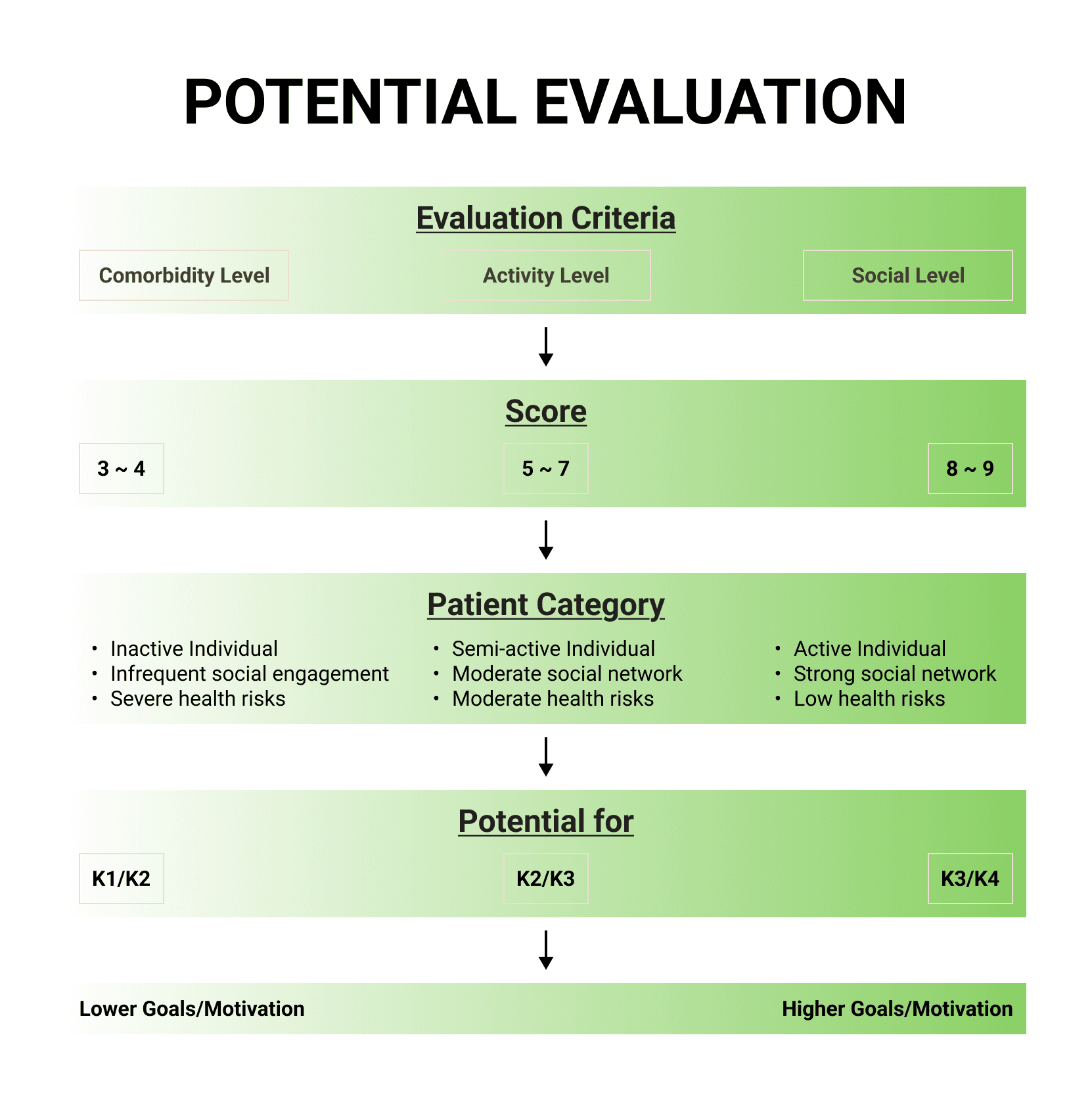
This gives the physician and insurance company context on the patient's rehabilitation potential. Metrics such as frequency of physical activity, social engagement, and underlying health risks are measured.
The test captures a wholistic view of the patient's "potential" through the consideration of a wide range of metrics. Standardized scoring streamlines the assignment process, reducing subjectivity throughout the process.
My responsibilities
Researching & defining functional differences between K-Levels
Identifying flaws in the current physical examination (Amputee Mobility Predictor)
Potential Evaluation Form: researched the psychological factors impacting post-surgery rehabilitation
Diagrams to visually communicate the various processes
This project was done in collaboration with 3 mechanical engineering students for a project in the University of Washington's Intro to Biomechanics class.
01
Project Definition
PROBLEM
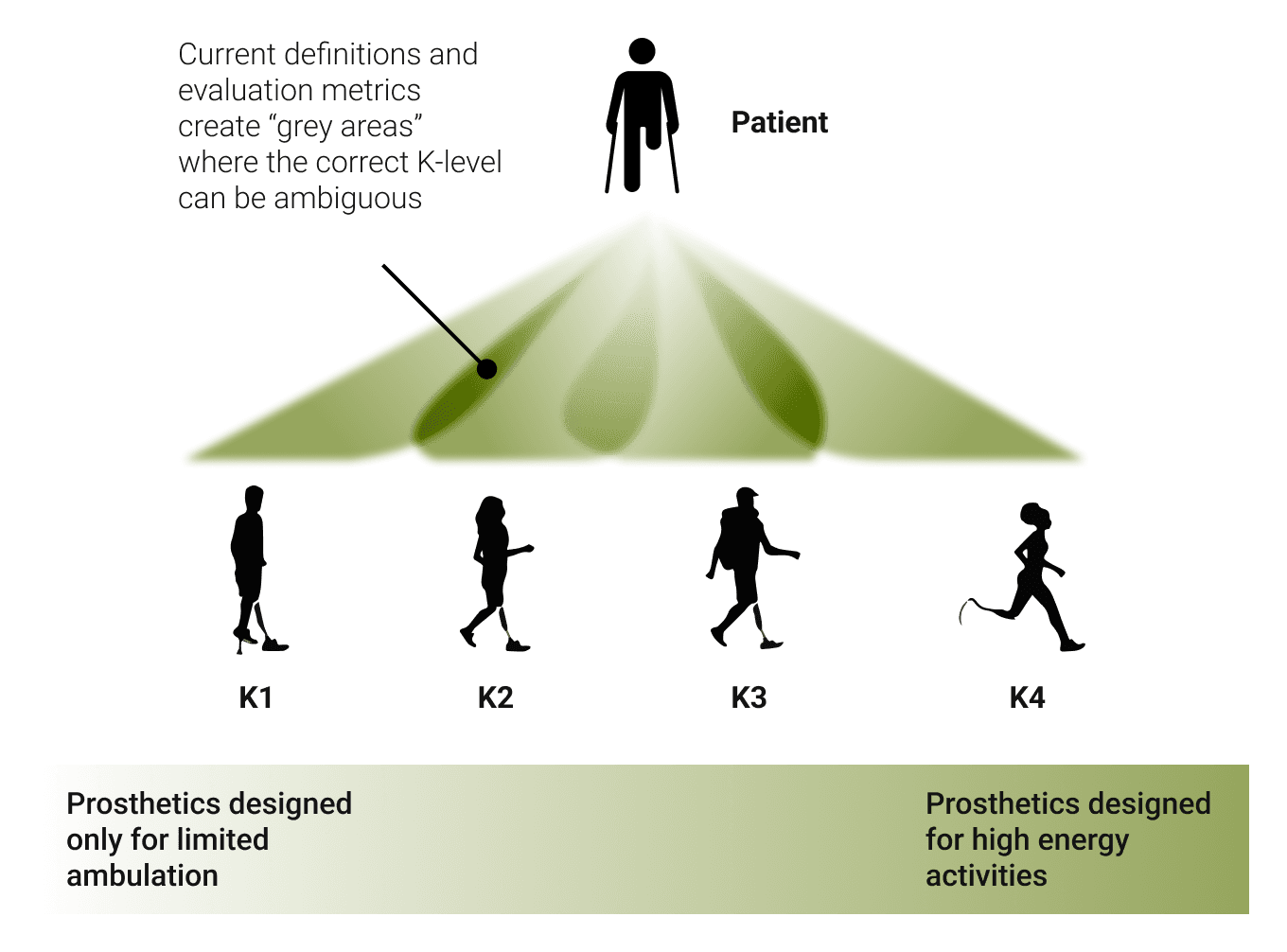
“Potential” is evaluated and assessed differently across clinics
Official K-level definitions provided by the CMS (listed below) are brief and ambiguous.
Currently up to the prosthetist and physician to conduct tests + converse with the patient to assign an appropriate prosthetic.
No set of standardized metrics to guide the synthesis of patient information, resulting in incorrect K-levels that inhibit the patient's rehabilitation journey.
GOAL
Predicting K-Levels with higher accuracy
Consider a wide range of factors (both physical and psychological) that are indicative of ambulation potential.
Increase objectivity in the process to make it easier for the healthcare professionals to gather proof of medical necessity.
02
Concept Development
K0

No potential to ambulate or transfer safely with or without assistance. Prosthesis does not enhance their quality of life or mobility.
K1

Potential to perform transfers / ambulation on level surfaces at fixed cadence. Typical of the limited and unlimited household ambulator.
K2

Potential to traverse low level environmental barriers (curbs, stairs, or uneven surfaces). Typical of the limited community ambulator.
K3

Potential for ambulation with variable cadence. Capable of traversing most environmental barriers (community ambulator). May have activities that demands prosthetic utilization beyond simple locomotion.
K4

Potential for ambulation that exceeds basic ambulation skills (high impact, stress, or energy levels). Typical of the prosthetic demands of the child, active adult, or athlete.
K-Level Definitions as provided by the Center for Medicare and Medicaid Services [1]
Patient
Return to the activities of daily living (ADLs) → K-level compliments their individual lifestyle
Prosthetist
Maximize the rehabilitation outcome for the patient in their care.
Clinically relevant outcome measures are helpful for assigning K-levels.
Physician
Evaluate the patient, gather proof of medical necessity → assign K-level.
Clear documentation for insurance purposes → Standardized, clinically relevant outcome measures are helpful.
Insurance Company
Provide care that is “reasonable and necessary”; avoid over-spending and minimize expenses.
Concept generation
Initial concepts were focused on making the process more objective:
An interview with a research prosthetist was conducted to gain additional insight on the evaluation process

Dr. Kate Allyn (Research Prosthetist at the University of Washington)
It helps to have a full physical exam + personal conversation on goals + typical activities
It is important to get to know your individual patient to determine what is important to them
We realized that an overly objective process is more harmful than it is helpful – a rigid system makes it difficult to accommodate for various special circumstances.
Revisiting our design path
Current Process

Physical tests need to reflect the patient's current physical capabilities.
Physicians and prosthetists need to decide, making the process time-consuming and subjective.
Without a standardized scoring system, the synthesis of patient information is prone to subjectivity.
Some professional may believe current capabilities are important, while others will rely more on the patient's ambulation goals.
This can happen during the transfer of information between the prosthetist and physician, or between the physician and the insurance company.
After reflecting on the shortcomings of the current process, we realized that focusing on making the test more objective through physical metrics was not the right choice for making an equitable evaluation system; a holistic consideration of both physical and psychological metrics was needed.
The new requirements were defined as:
Ease of Implementation
System/test can be implemented w/o significant investment (cost of system itself + time to train clinicians to use the technology)
Time Efficiency
Whole assignment process < 90 minutes
Comprehensive
Considers both psychological and physical factors
Standardization
Scoring system for consistent results
Since none of our concepts met these requirements, we needed to conduct more research to find a path forward.
03
Concept Refinement
Nine significant variables relating to K-levels were found
A study that developed a machine learning algorithm capable of predicting K-levels with high accuracy (93%) was referenced.
For K-level classification, balance, BMI, and level of amputation were found to be the most influential [4].
Balance
Amputation Level
Beck Depressive Inventory (BDI)
BMI
Intact extremity (IE) plantar flexor strength
IE hip extensors strength
Age
Multidimensional Scale of Perceived Social Support (MSPSS)
functional differences across K-levels
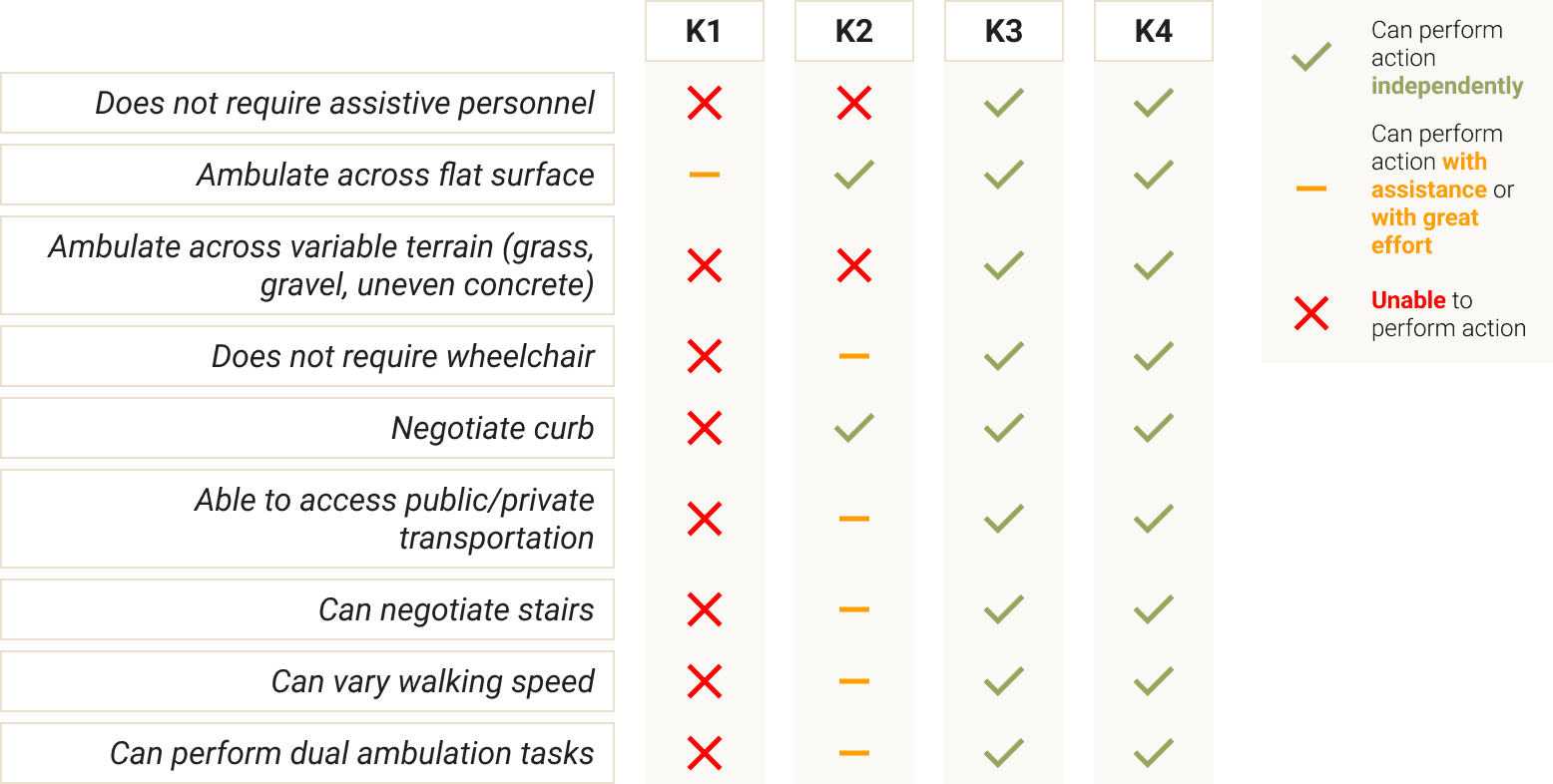
Source: Center for Medicare and Medicaid Services, Lower Limb Prosthesis Policy Article, 2025 [1]


Clinician-assigned vs. Predicted K-levels from Amputee Mobility Predictor [3]
Demonstrates core + lower limb strength to perform rapid, irregular movements
Good for eliminating ceiling effects
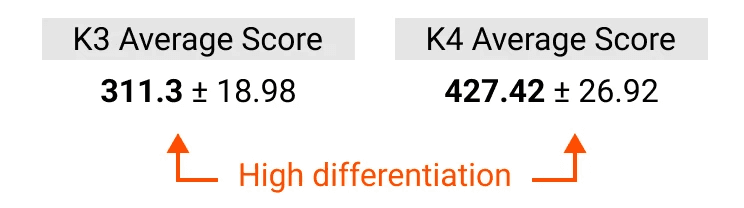
Average scores for 6MWT for K3 vs. K4 [2]
result
Final Design

Physical Examination.
The current physical capabilities such as balance, gait speed/quality, and strength of intact/residual limb are evaluated in one single test.
A single, comprehensive score makes it easier to summarize patient information when submitting coverage claims.
Motivation
The “potential” category is intentionally more subjective. Standardized metrics are used to streamline the evaluation process, but the final decision is ultimately up to the physician’s professional opinion. This makes it easier tailor the K-level to individual needs.
Individuals who were active prior to amputation (both physically and socially) are more likely to be motivated to return to that lifestyle.
Physically limiting factors such as underlying health risks and amputation level to provide a realistic assessment.

References
[1] E. H. Beisheim, J. R. Horne, R. T. Pohlig, and J. M. Sions, "Differences in Measures of Strength and Dynamic Balance among Individuals with Lower-Limb Loss Classified as Functional Level K3 Versus K4," Am. J. Phys. Med. Rehabil., vol. 98, no. 9, pp. 745–750, Sep. 2019. [Online]. Available: https://pmc.ncbi.nlm.nih.gov/articles/PMC7309599/.
[2] L. Bo’sher, S. Chan, I. G. Ellen, B. Karfunkel, and H. Liao, "Accessibility of America’s Housing Stock: Analysis of the 2011 American Housing Survey (AHS)," U.S. Department of Housing and Urban Development, Office of Policy Development and Research, Mar. 19, 2015. [Online]. Available: https://www.huduser.gov/portal/sites/default/files/pdf/accessibility-america-housingStock.pdf.
[3] M. P. Dillon, M. J. Major, B. Kaluf, Y. Balasanov, and S. Fatone, "Predict the Medicare Functional Classification Level (K-level) using the Amputee Mobility Predictor in people with unilateral transfemoral and transtibial amputation: A pilot study," Prosthet. Orthot. Int., vol. 42, no. 2, pp. 191-197, Apr. 2018. [Online]. Available: https://pubmed.ncbi.nlm.nih.gov/28534664/.
[4] A. Knezevic et al., "Machine Learning Model for Predicting Walking Ability in Lower Limb Amputees," J. Clin. Med., vol. 13, no. 22, p. 6763, Nov. 2024. [Online]. Available: https://doi.org/10.3390/jcm13226763.